
Why Your Psychology Practice Needs a Brand and Not Just a Logo
Let me guess how your branding journey went: you got registered, you got a logo (maybe from a designer, maybe from Canva at 11pm), you picked some calming colours, and you called it done. Logo? Tick. Brand? Sorted.
Except... it doesn't feel sorted, does it?
Your Instagram doesn't quite match your website. Your intake form is in a different font to everything else. And despite doing genuinely excellent clinical work, your enquiries don't reflect it.
Here's the uncomfortable truth most practitioners are never told: a logo is not a brand. And the difference between the two is quietly costing practices like yours new clients every single week. Let's fix that.
Being good at what you do doesn't fill your appointment book
You trained for years to do exceptional clinical work. But somewhere between your first client and your fiftieth, you probably noticed something: clinical skill alone doesn't generate bookings.
What fills your appointment book is trust, and in a world where your next client finds you on Google at 10pm, scrolls your Instagram, and reads your website before they ever pick up the phone, trust is being built (or lost) long before you say a word.
That pre-conversation trust-building? That's your brand's job.
What a brand actually is
Your brand is not your logo. Your logo is one ingredient.
Your brand is the complete impression someone forms of your practice from every touchpoint, your website, your Instagram feed, your Google Business listing, your intake forms, your booking confirmation email, even your email signature.
When all of those touchpoints are consistent, professional and aligned, people feel something before they've spoken to you. They feel like you're trustworthy. Like you know what you're doing. Like you're the kind of practitioner they'd feel safe sitting across from, and for someone taking the brave step of reaching out for support, "safe" is the whole decision.
When your touchpoints are inconsistent, generic, or clearly an afterthought?
People feel that too. They don't email you to tell you. They just don't book.
The three things your brand must communicate
1. That you're credible and professional
Here's the psychology of it (you'll appreciate this): a first-time visitor has no way to assess your clinical skill, so their brain uses what it can assess as a proxy, and that's your visual presence. Fair? Not entirely. Real? Completely. A consistent, professional brand signals that you take your practice seriously, and by extension, that you'll take them seriously.
2. That you serve a specific person with a specific problem
The practices that consistently attract their ideal clients do one brave thing: they speak clearly to one type of person about one type of problem. "Psychologist offering therapy for a range of concerns" describes thousands of practitioners. "Helping anxious high-achievers in Brisbane stop running on empty" describes you, and the right client recognises themselves instantly.
Specificity feels limiting. It's actually magnetic.
3. That you're consistent
Consistency is trust made visible. When your Instagram looks like your website, your forms match your brand colours, and every email sounds like the same human wrote it,you come across as a practice that has its act together. Every mismatch, on the other hand, is a tiny crack in the trust you're building.
One crack won't lose a client but seven might.
Where to start (a 10-minute self-audit)
If you suspect your brand isn't doing this work for you, don't rush off and buy a new logo, start by seeing what a new client sees.
Pretend you've just found your practice for the first time. Open your Google listing, then your website, then your Instagram, in that order, because that's the order clients experience them. Then ask two questions:
Do I immediately understand who this practitioner helps?
Do I trust them?
If either answer is no, or even a hesitant "sort of", you've found your starting point.
Want the structured version? The Free Brand Clarity Scorecard assesses your practice across the six pillars of our Brand Clarity Framework: Viewer, Vocation, Vision, Visual, Voice and Vibe, in about 10 minutes, with instant results showing exactly where your gaps are.
The bottom line
You don't need to be louder, trendier, or on TikTok. You need every touchpoint of your practice telling the same trustworthy story, who you help, what you stand for, and why they're safe with you. That's a brand. A logo just signs its name.
And if the scorecard shows gaps you'd rather not tackle alone, that's exactly what our branding for psychologists work is for. Or if your brand foundations are solid and it's your day-to-day materials letting you down, the Mental Health Practitioner Launch & Social System applies your branding across 200+ templates, forms and content, practice looking sorted by Monday.
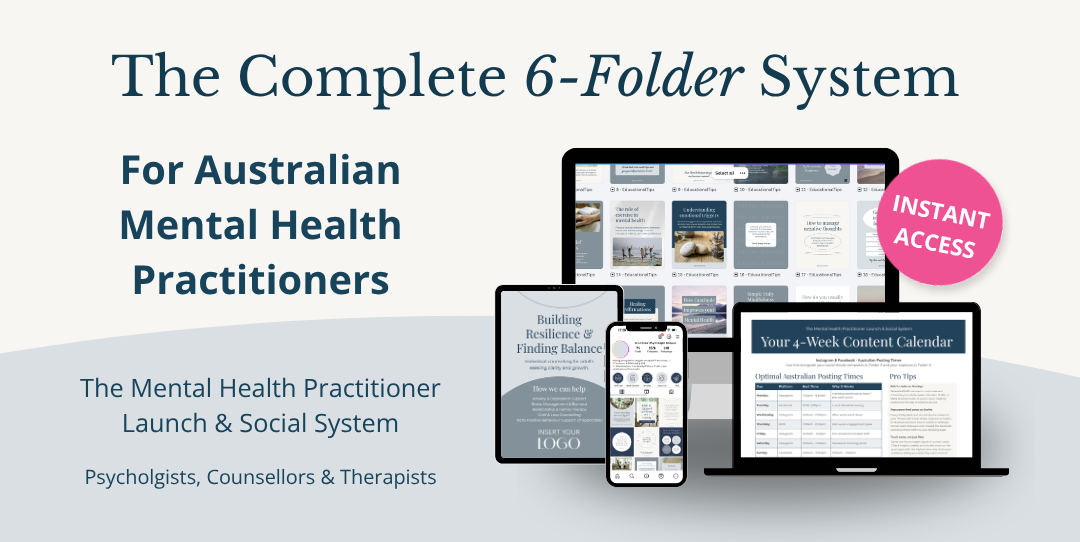
The Mental Health Practitioner Launch & Social System - $697
FAQ
What's the difference between a brand and a logo for a psychology practice? A logo is a single visual mark; a brand is the complete impression a practice creates across every touchpoint, website, social media, Google listing, forms and emails. A logo identifies your practice, while a brand builds the trust that makes clients book.
Why does branding matter for psychologists and therapists? Clients choose a practitioner based on trust, and most of that trust is formed online before first contact. A consistent, professional brand signals credibility and safety, while an inconsistent one quietly loses bookings without practitioners ever knowing why.
How do I audit my psychology practice brand? View your practice as a new client would: open your Google listing, website and Instagram in sequence and ask whether you'd immediately understand who the practice helps and whether you'd trust them. A structured option is the free Brand Clarity Scorecard, which rates your brand across six pillars in about 10 minutes.
Do I need a new logo to improve my practice brand? Often, no. Many practices don't need a new logo, they need alignment: consistent colours, fonts, messaging and tone across every touchpoint. An audit first tells you whether the problem is the logo or the consistency around it.
Written by Christal Giblett Squarespace Design Partner | Brand Strategist | Identity Designer
Christal helps psychology, NDIS and allied health businesses across Australia create strategic brands and websites that build trust and generate more enquiries. She's the founder of Lilaco Designs, based in Mackay, Queensland, and the creator of the Brand Clarity Framework.